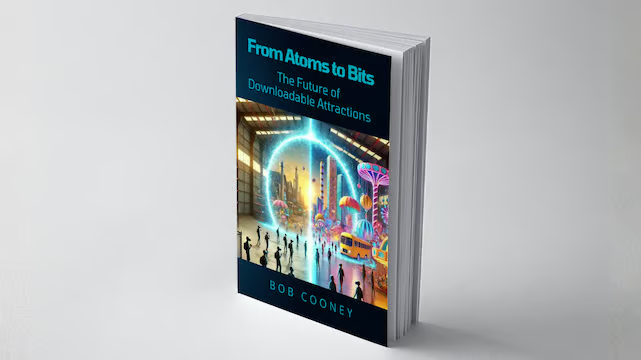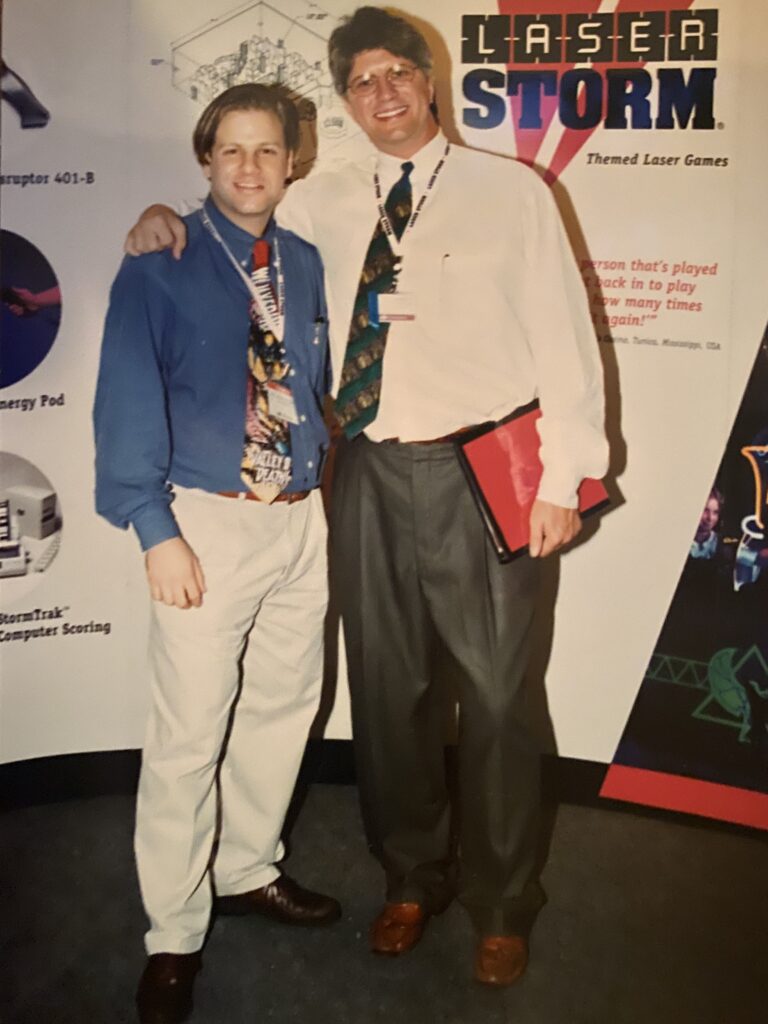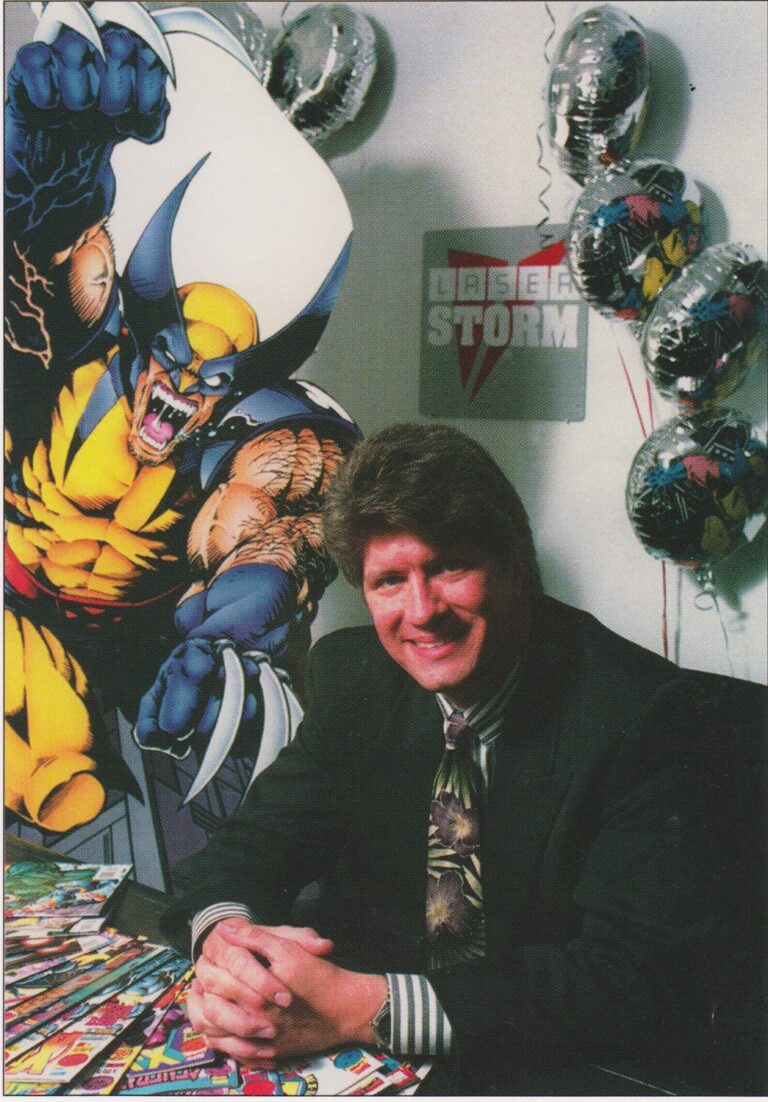
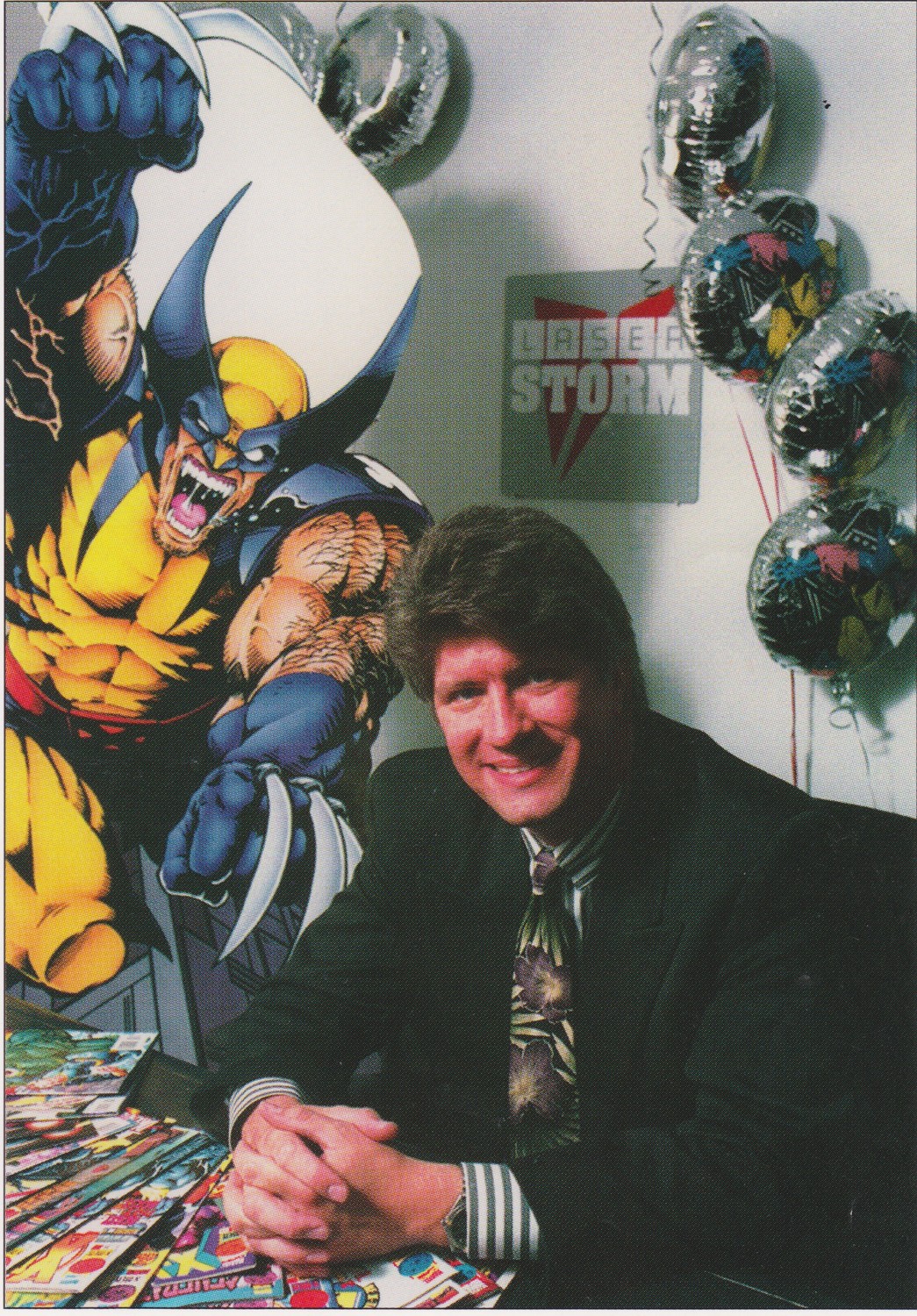
This is an excerpt from my upcoming book, From Atoms to Bits: The Future of Downloadable Attractions. In the first part of the book, I reflect on some of the biggest lessons from my days building the themed, interactive entertainment company, Laser Storm. Most of those early lessons still apply.
Storytelling is one of the most important skills for an entrepreneur. If you want to get your company off the ground, it needs a compelling story. It’s how we recruit employees, investors, and customers. Humans might justify decisions with facts, but they make decisions with emotions. And emotions come from stories.
In the 1980’s I worked as a penny-stock broker in Denver, Colorado. If you’ve ever seen the movie, The Wolf of Wall Street, I was one of those guys in the shirt and tie sitting in the middle of “the bullpen,” smiling and dialing all day long. One of my clients had invested in a blind pool, a blank check company that raised a few hundred thousand dollars with the intention of merging into a larger company that wanted to go public. Today they’re called SPACS – same thing but with way more zeroes.
This particular blind pool wanted to take the money and build a laser tag business. My client wanted me to check it out for him. I got on a call with Mark Young, the company’s CEO, and he told me the story. I was curious, but certainly not sold on it. So he invited me up to check it out. I drove up Highway 36 to Boulder and pulled into the strip mall parking lot, where Mark greeted me and invited me inside.
We played for half an hour. At the end, I was exhausted, sweating, and had torn holes in a pair of brand new jeans. It was so worth it. I hadn’t had that much fun in a long time. Mark knew it too; it was impossible to hide. I told him I could see why he was so excited about the potential of this for a business.
He said he needed to convince his board and shareholders that this was the best direction for the company. He raised the money as a blind pool on the promise of a reverse acquisition, and this was a significant pivot. He needed a story. So I told him that I would write the business plan for them as the next step. We agreed, and I drove back home to Denver.
If it weren’t for one of my best clients asking me to investigate, I would never have driven an hour to meet him. Mark didn’t have a good enough story. But once I had the experience, my emotional brain kicked in. It was only after that that I spent the next two weeks at the Denver Public Library, uncovering the facts and data to support my emotional decision to invest time and energy into the project.
Humans are evolutionarily wired for stories. In tribal days, human survival depended on stories about whom to trust, where danger existed, and how to interpret the unknown. Stories allowed us to create communities and make sense of the world, which gave humans an evolutionary advantage.
Stories activate the emotional centers of our brains, making memories stickier. It’s hard to get emotional about data, but when facts are packaged as stories, they’re more likely to stay with someone. The most successful companies of my lifetime developed powerful story-driven brands that customers, employees, and investors rally around.
Today, stories are more important than ever because facts have become less clear. The rise of meme stocks in 2021 is a great example. GameStop, the video game retailer, had very little going for it in the fundamental business category. Many analysts saw a bankruptcy in its future. But a few investors created a story, spread it across the internet, and the stock went ballistic.
Word on Reddit was that hedge funds had massively shorted the GameStop stock (selling borrowed shares, betting the price would drop so they could cover by buying them cheaper later and making a profit). Small investors banded together to drive up the price, costing institutional investors millions. It was a story about the little guy pushing back against Wall Street’s greed.
Similar stories drove wild stock price swings in companies like AMC Theaters and Bed Bath and Beyond. The fundamentals of those companies were ignored. All that mattered were the stories.
Back in the late 1980s, nobody had heard about laser tag. They had no idea what it was, so I’d try to explain.
“Imagine you step into a dark room, with fog swirling around, and there are glowing objects everywhere. A beam of light cuts through the fog, and you duck for cover behind a wall. You signal for your teammates, as dramatic music urges you on. You see the enemy, raise your blaster, and before you can fire, you’re lit up like a candle.”
Most people were intrigued by this story, but they weren’t sold on it. I was explaining the process of playing laser tag, but there was no emotional hook.
If only I could get them to play like that night in Boulder. Anyone who’s guided someone through their first outstanding VR experience knows exactly what I mean. But unlike VR, Laser Storm required an entire arena. Not something I could pull out of my backpack. If Laser Storm were going to go public, I needed to convince rooms full of stockbrokers and analysts that this was the next big thing.
Laser Storm wasn’t about laser tag. It wasn’t even about “themed, interactive, entertainment,” the tagline we developed. It was about helping people play. In a world of ever-increasing complexity and stress, we gave people a chance to recapture, even for just 15 minutes, what it was like when they were a child. And that was priceless.
When I asked prospective investors when the last time they got down on their hands and knees, crawling around in the dark pretending they were Luke Skywalker evading Darth Vader, I could see it. That glint in their eye, or a forlorn expression from the realization that all work and no play made John a dull boy.
That was the story of Laser Storm. It was selling affordable fun, in 15-minute increments, with no cost of goods sold. More than one investor made the joke comparing it to a brothel. I just nodded and smiled as I asked them how much they’d like to invest.
Many of the entrepreneurs and founders I meet struggle with their story. They’re so close to the business that they can’t pop up high enough into the stratosphere to gain the perspective required. They’re down in the weeds running the company.
I’ve helped dozens of companies craft their story. Whether it’s for raising money, launching a new product, or rebranding, the story is what anchors everything. If you need help with your story, reach out. I offer a facilitated workshop to help you get to the heart of your story.
And if you want to read more of From Atoms to Bits: The Future of Downloadable Attractions as it comes together, you can join my Bookwriting Space at LEXRA