Three groups wrote free-roam VR interoperability rules in six weeks. KDDI and STYLY launched the 25-company Location-Based Experiences Consortium in Japan on 28 July. UNIVRSE and Small Creative launched LBXR eXchange at Venice Immersive on 3 September. A third initiative is forming around the China Film Administration.
As an expert in go-to-market consulting for VR and location-based entertainment, I’ve found that growth hinges on how content gets into venues. A standard is a distribution channel. Every platform arrives at a venue as its own operating system. This is the first time I’ve seen the industry admit in public that it’s a problem.
Both published efforts point at cinema for their precedent. LBXR eXchange is modeled on the Digital Cinema Package. LBEC’s site cites DCI. The precedent that fits this business is older, and it comes from the amusement industry. JAMMA is the arcade wiring standard the Japanese manufacturers published in 1985. Neither group is copying what made it work.
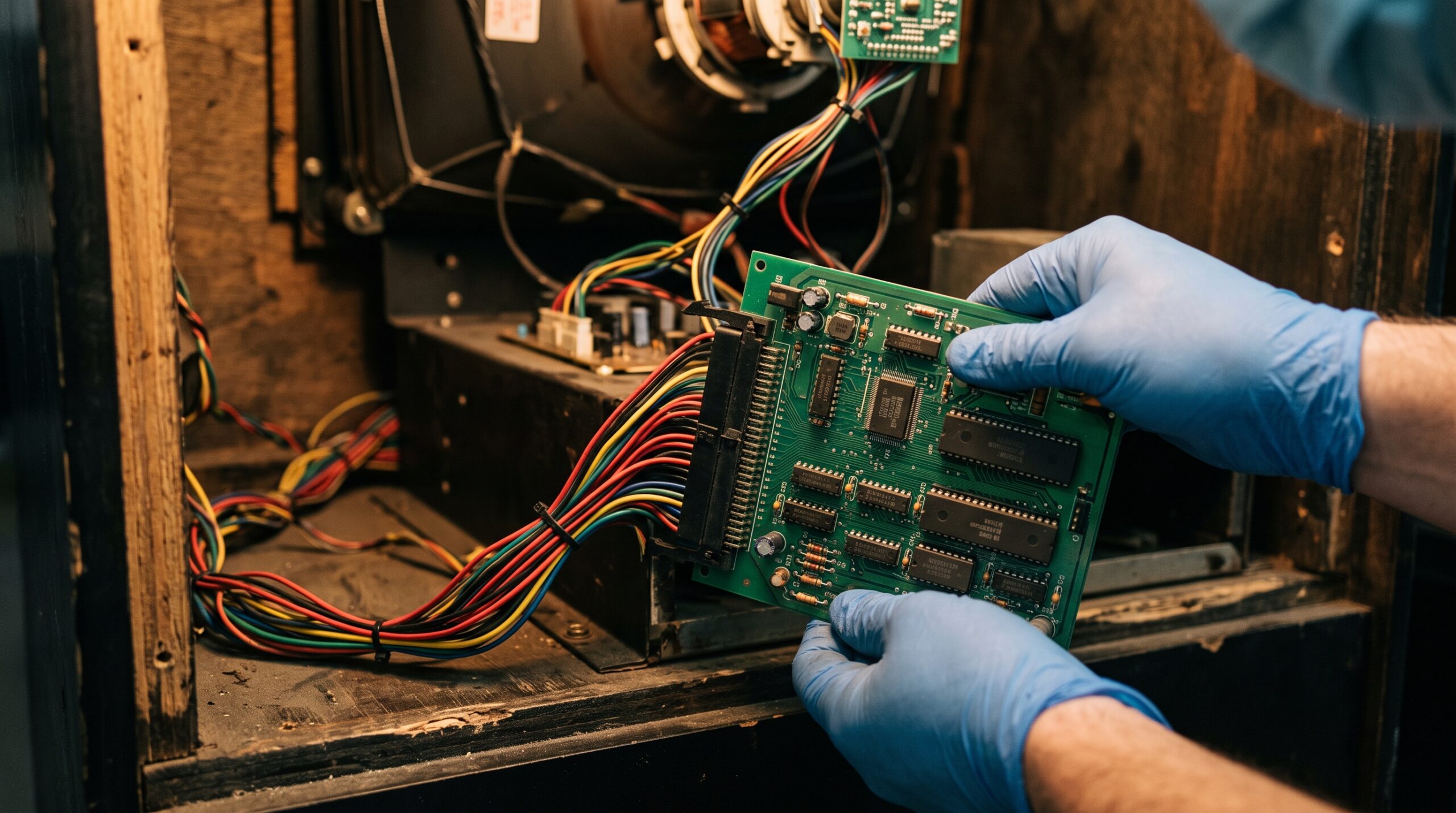
In the 1980s, an arcade game came in two parts. The game itself was a circuit board. The cabinet was everything around it: the screen, the joystick and buttons, the speaker, the coin slot and the power supply. The board plugged into the cabinet through a wiring harness, and every manufacturer wired its harness differently. Nintendo, Sega, Namco and Atari each had their own.
So when a game stopped earning, which every arcade game does within a year or two, the operator had two choices: buy a new cabinet, or pay a technician to rewire the old one for the new board. Game makers had the mirror problem. A new game could only go into cabinets wired for it, so selling a game usually meant selling a cabinet.
In 1985, the Japan Amusement Machinery Manufacturers Association, the trade body the manufacturers had set up in 1981, published a standard connector. Fifty-six pins in a fixed order, carrying power, the controls, the picture, the sound, and the coin signal. Any cabinet wired to it accepted any board built to it.
After that, an operator changed games by pulling one board out and plugging another in. A small developer could sell a board to every arcade in the world without ever building a cabinet. The game stayed proprietary. The connection to the venue became common. The game makers won, because every cabinet already standing on an arcade floor became a place they could sell a new game into. Operators also won because they could extend the life of the cabinets, increasing the lifetime value of each investment
LBEC’s site has the history right. “DCI standardized film, JAMMA standardized games, and ISO standardized the shipping container,” it says. In each case, it says, “the standard created distribution, distribution created exhibition, and exhibition created an enormous market.”
If I were writing the free-roam VR version, it would copy five things from JAMMA and answer one question JAMMA never had to.
Draw the line at the venue. Everything upstream of the experience runtime stays with the studio: the engine, the runtime, multi-user sync, tracking, the creative. Everything the venue staff touch becomes common: the console, the headset fleet, check-in, guest preferences, telemetry, and the support number. JAMMA drew the line at the edge of the board. This one gets drawn at the edge of the runtime.
Certify the content, and let the venue inherit it. JAMMA certified boards. A compliant board played in every compliant cabinet. The work of complying fell on the game maker, who got the distribution in return. Here, the studio integrates once against a standard interface and reaches every operating platform.
Keep it thin. JAMMA was 56 pins. It carried signals and nothing else, and it lasted eleven years. Standardize what touches the operator and stop there. The moment the spec reaches into how a title is authored or rendered, the studios will walk, and they’ll be right to.
Nobody who sells a platform gets to own it. The 1985 spec came from a manufacturers’ association. A standard owned by one platform asks its competitors to build their distribution on a rival’s technology, and they won’t.
Answer the money before the pinout. An arcade operator bought the board outright and kept every coin. A free-roam studio gets a share of the ticket. I built the LBE VR Game Distribution Calculator to show how that math works. It’s the part of a go-to-market strategy I rarely (never?) see a studio document. Any shared layer between studio and venue has to track that split and pay it out. The studios, platforms, and operators have to agree on it before anyone writes the spec. Cinema had the same problem and solved it with the Virtual Print Fee. It shifted the cost savings of physical film reels from studios to theaters until the new digital projectors were paid off. Free-roam VR needs the equivalent, and the VR arcade game market has already figured it out.
Version it. JAMMA replaced its own connector with the JAMMA Video Standard in 1996 when digital I/O outgrew 56 pins. Whatever gets written now will need replacing, so the spec needs a way to change without breaking every venue that runs it.
LBXR eXchange has the direction backward.
It is founded by two content platforms, UNIVRSE with XRoam and Small Creative with OnSite. Each ships a runtime, a console, and a catalog. Before 1985, the arcade business worked that way, with each manufacturer publishing its own harness. It didn’t work. The release says the ambition is “not to introduce another proprietary solution” and that the initiative “may progressively welcome additional companies”. Good. But a standard written by two studios will be built around what studios need. The operator’s problems- one console, one check-in, and one support number- come second.
The model it names is the Digital Cinema Package, a file format. DCP solved content portability: one master plays on any certified projector. That’s the problem of moving a title between platforms. It says nothing about how the cinema runs the projector, sells the ticket, or calls for help when the lamp fails. Those are the problems a multi-title venue has today.
LBEC starts from the building. Its first deliverable is a specification of what a venue must provide before content can be installed: floor area, ceiling height, power and network. That’s useful, but it’s the easy half. It tells a studio whether its title fits the space. It does nothing about the studio still arriving with its own console, its own check-in and its own support desk.
Its 25 members are mostly landlords, banks, rail companies, broadcasters and ad agencies, with a handful of XR studios. The 1985 spec was written by the game makers. LBEC has hardly any makers. LBEC’s target is ¥15 billion of content distributed through the consortium by 2030. That’s a sales target. The interface still has to be written.
And it’s Japanese, which worked for JAMMA because that’s where nearly all the arcade games were developed and manufactured. But LBEVR is global. Content is coming from at least 3 continents and a dozen countries. If Japan writes a spec, Europe writes one, and North America does too, an operator with content from different countries is back to running parallel systems.
A trade association has to hold this standard, with operators and studios writing it together. That’s how JAMMA got written. LEXRA is the trade association for location-based XR, and it’s the natural place for the conversation.
Many of the key players will be in Dallas for the LEXRA Summit, Oct 5-6th in Dallas. The second half of the agenda is about content/market fit. Operators must have a diverse content slate to serve the markets available on Tuesday afternoon and Friday night. No one studio can provide that (at least today). Get your tickets at www.summit.lexra.org
A 1985 arcade wiring standard from the Japan Amusement Machinery Manufacturers Association. Its 56-pin edge connector let any compliant cabinet run any compliant game board, so operators swapped titles by swapping boards.
An open initiative launched by UNIVRSE and Small Creative at Venice Immersive on 3 September 2026. It explores interoperability across location-based XR, modeled on the Digital Cinema Package.
LBEC is a 25-company Japanese consortium run by KDDI and STYLY that starts with venue specifications. LBXR eXchange is founded by two content platforms and starts with shared principles and a venue label.
It is the cinema precedent where the content side paid toward the operator side’s equipment. Free-roam platforms earn a share of ticket revenue, so a shared standard needs an answer on who pays.
Everything venue staff touch: console, headset fleet, check-in, guest preferences, telemetry and support routing. Everything upstream of the experience runtime stays with the studio.