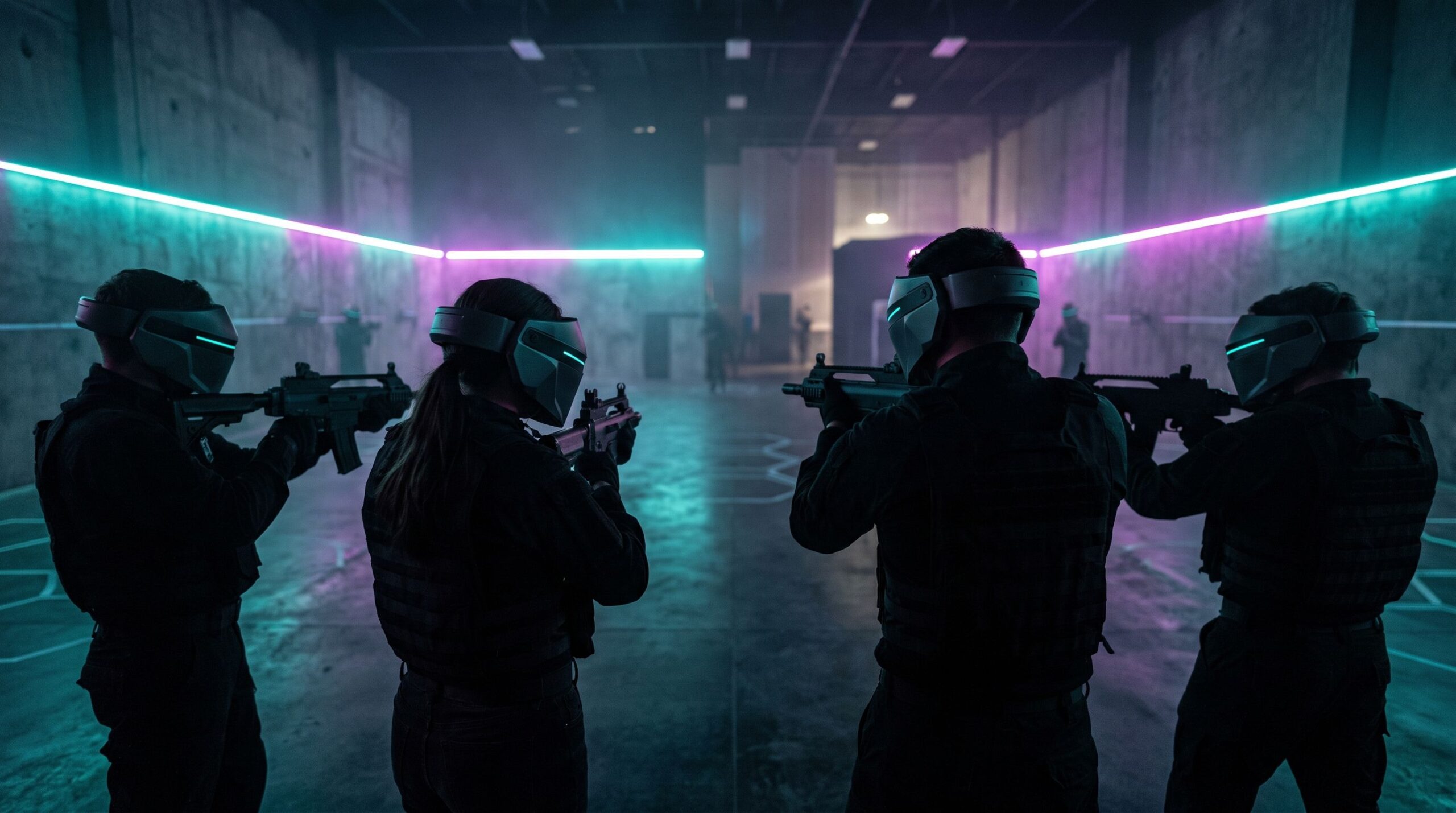
Sandbox VR keeps expanding. In March they announced they’ve passed 80 locations across 13 countries and five continents, with over $300 million in lifetime ticket sales and 5 million lifetime players. For context, they crossed $200 million in April 2025 — which means roughly $100 million of that total came in the past year alone.
I’d been wondering about Sandbox VR’s shift from corporate ownership to franchising for a while. As a VR consultant, I’ve questioned, publicly and privately, the single-unit economics of their stores. Last fall I posted on LinkedIn, noting that smart money operators are opening sites rapidly.
LOL Entertainment is developing multiple sites in the US, adding Washington, D.C. and Baltimore to their pipeline this spring. Royal Casino opened its third in Germany, and Next Level Entertainment is developing 10 sites there as well. These are smart companies; so the economics must be solid, right?
Sandbox CEO Steven Zhao shared my post, saying that anyone who questioned their profitability could request a copy of their Franchise Disclosure Document, or just Google it. I kept meaning to do that, but you know, it never felt urgent enough.
Then their SVP of Marketing, Matthew Kellie, appeared on the CMO Weekly podcast. I figured I would pick up some marketing tips I could share with my LEXRA members. His interview had some great insights. As I sat down to write about them, I started thinking about Steven’s challenge to review their FDD. So I did. You can check it out for yourself at this link. This post is my personal take. Do your own research and hire an attorney with franchising experience if you’re considering investing.
Sandbox VR started in the US, opening company stores at a rapid pace. As of the most recent report, they own and operate 33 of the 36 stores in the US. The average US location generates $1.7 million in revenue per year with a 40% EBITDA, which is almost $700K. Assuming it costs them $1 million to build a site, that’s a great return on capital. I would do that all day long.
Now this does not account for corporate overhead, content licensing and development, etc, etc. But the single-unit economics are excellent. Open enough sites, and have a very profitable enterprise.
But for franchises, it’s a very different story. Sandbox charges 21-27% off the top for content, franchise fees, and brand development, something they don’t need to factor into their corporate store P&L. Take 25% out of 40% EBITDA, and there’s only 15% left. (I know, I’m a math wiz, right?). They also take 11% for marketing, but that’s gotta be spent anyway, and my guess is Sandbox is more efficient with their spend than an individual franchisee would be. Maybe.
| Fee | Percentage of Gross |
|---|---|
| Franchise | 5% |
| Experience Fee (Content) | 15% |
| 3rd Party Content | 4-6% |
| Brand Development | 1% |
| Digital Marketing | 5% |
| Non-Digital Marketing | 1% |
| Online Marketing* | 5% |
*It’s unclear to me if the Online Marketing spend, which is to be directed to the franchisor’s designee (ie, an agency), is in addition to the Digital Marketing, or is the same thing. Since they gave it a different title, and it’s in a different section of the FDD, I suspect it’s in addition, which is why I listed it. See for yourself in Section 7 on page 18 of the Franchise Agreement.
Depending on landlord buildout allowances, the cost to open a Sandbox franchise could range from $1.4 million to over $2 million. 15% EBITDA on a $1.7 million revenue business leaves $255K a year on the bottom line. If the average franchise costs $1.5 million, that’s a six-year ROI. And that’s based on EBITDA.
The “D” in EBITDA stands for “depreciation.” And while the fixtures and construction might depreciate over the term of the lease (10 years), the tech stack will only have a useful life of about 4-5 years, max. So before you get your money back from the initial investment, you’re reinvesting in new or upgraded technology.
Sandbox mentions this in the FDD: franchisees only have a one-year guarantee of support on an experience based on current technology. They can be forced to upgrade at any time. Zero Latency has been on its 3rd-generation system for a decade. With markerless motion capture on the horizon, you can see the next upgrade coming soon.
Markerless will reduce labor costs and improve the customer experience. Hopefully, Vicon, which makes the current marker-based tracking system, will use the same cameras for its markerless system, reducing the cost of future upgrades. But markerless requires a lot of GPU power, so there will be server costs.
So now I think I know why Sandbox went so hard on franchising and stopped building company stores. If they can capture 25% of a franchise site’s revenue vs 40% of a corporate store, with almost zero relative acquisition cost, it’s a no-brainer. And they get the leverage of multiple franchisees building simultaneously, where a corporate rollout to 250 global sites would require a huge internal team and tons of contingent lease liability.
Through franchising, they can grow fast with a lot less capital. And the $300 million milestone shows the strategy is working — for Sandbox. The problem is, those franchise economics still look thin to me. So the puzzle has shifted from “why did Sandbox move so hard into franchising?” to “why is smart money building so aggressively?”
Have some ideas, or even better, informed answers? Reach out and let me know what I am missing.
And if you’re building a VR arcade or LBE, and want the guidance of me and other industry experts, join LEXRA. It’s the most cost-effective way of increasing your odds of success.
Oh, and what about that interview with their SVP Marketing? I broke down his insights on The VR Collective: The Ultimate Guide to Marketing in VR: Insights from Sandbox VR’s CMO.
If you are planning around hardware, the other side of that bet is the consumer market that funds it. I wrote about what the smart glasses privacy backlash means for LBE in The Smart Glasses Backlash Was Predictable, and Meta Launched Anyway.